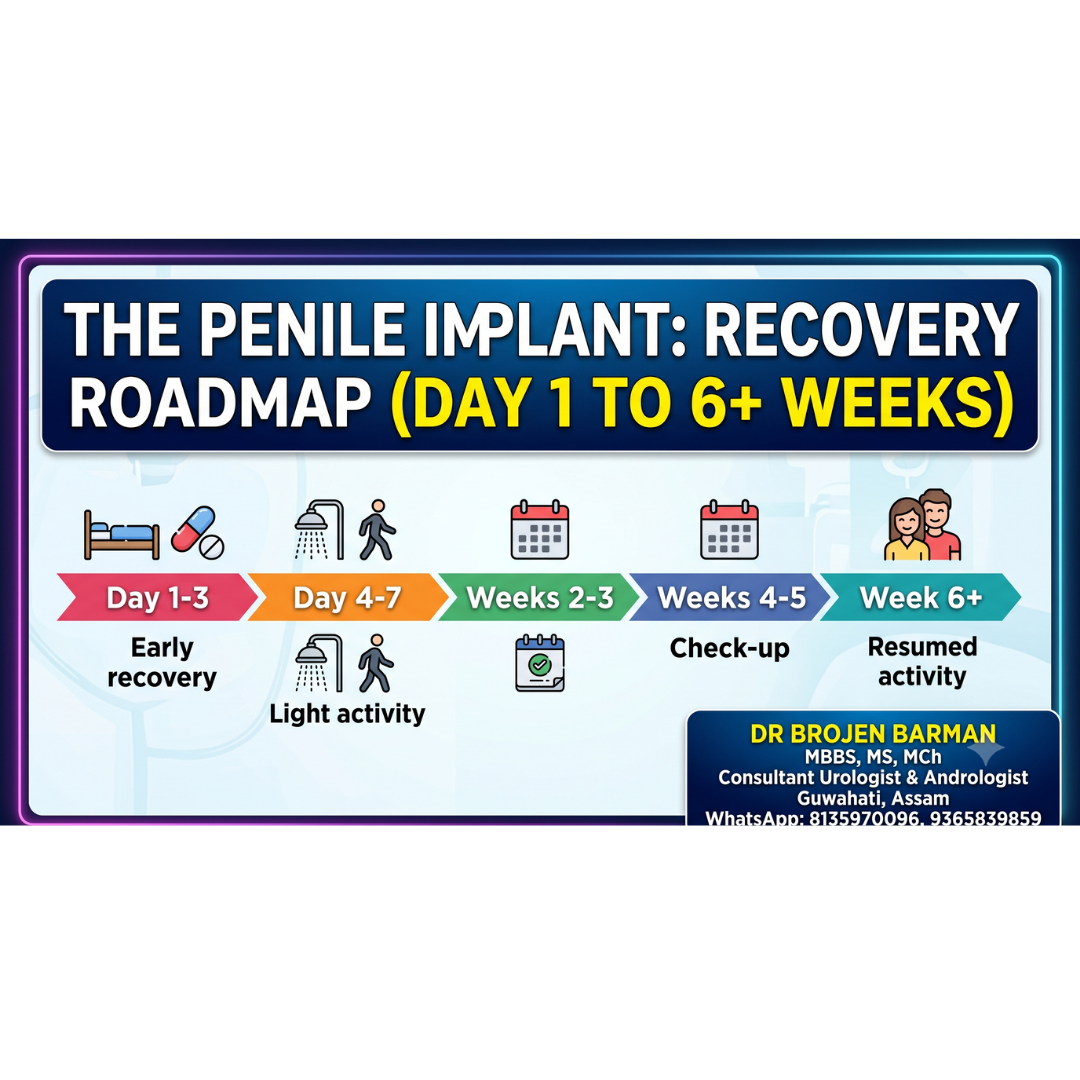
Recovering from Penile Implant Surgery: A Week-by-Week Guide
This guide explains what to expect during recovery from penile prosthesis (implant) surgery and how to manage each stage. Every patient heals differently, so use this as a general roadmap — always follow the specific instructions given by your surgeon.
Week 1: Immediate Post-Operative Period
What to expect:
Swelling and bruising of the penis, scrotum, and sometimes the lower abdomen — this is normal and often looks worse than it feels
Moderate to significant pain, especially in the first 2–3 days
A surgical drain (if placed) removed within 24–48 hours
A dressing or compression wrap on the penis, usually removed by your surgeon or care team within 1–3 days
Mild oozing or blood-tinged fluid from the incision
Difficulty urinating or a temporary catheter in place for the first day or so
The penis may sit in a somewhat unusual position (often pointing upward) due to swelling — this resolves as swelling goes down
Management:
Take prescribed pain medication on schedule, not just when pain becomes severe
Apply ice packs to the area for 15–20 minutes at a time during the first 48–72 hours to reduce swelling
Wear supportive, snug underwear (not boxers) continuously to support the scrotum and reduce swelling
Keep the incision clean and dry; follow specific wound care instructions (some surgeons allow gentle showering after 24–48 hours)
Avoid any manipulation, "cycling," or activation of the device during this period
Limit activity to walking around the house; avoid sitting for long periods
Avoid lifting anything heavier than 5 to 10 kg.
No driving while taking narcotic pain medication
Contact your surgeon immediately if you notice: fever over 101°F (38.3°C), spreading redness, pus or foul-smelling drainage, rapidly increasing swelling on one side, severe uncontrolled pain, or inability to urinate
Weeks 2–4: Early Healing Phase
What to expect:
Swelling and bruising gradually improve, though some residual swelling can persist for several weeks
Pain decreases significantly, often manageable with over-the-counter medication by week 2–3
The incision begins to heal and close; sutures (if not dissolvable) may be removed around this time
Skin sensation around the incision may feel numb, tingly, or hypersensitive — this is normal nerve healing
You may start to feel the pump (for inflatable implants) or the rods (for malleable implants) under the skin
Management:
Most surgeons ask patients to begin gentle "cycling" of an inflatable device around week 3–4 (inflating and deflating a few times daily) to prevent scar tissue from restricting the device — only start this when specifically instructed
Continue wearing supportive underwear
Gradually resume light daily activities; walking is encouraged to promote circulation and healing
Avoid strenuous exercise, heavy lifting, biking, or any activity that puts pressure on the groin
Sexual activity and masturbation are typically not yet permitted — most surgeons require waiting until at least 4–6 weeks
Attend your scheduled follow-up visit, usually around 2–3 weeks, so your surgeon can check healing and teach you (and your partner, if desired) how to operate the device
Watch for signs of infection, which can still occur during this window: increasing pain after it had been improving, new redness, warmth, or drainage
Weeks 5–6: Transition to Full Use
What to expect:
Swelling is largely resolved; the penis and scrotum should look and feel closer to normal
Most residual soreness resolves, though some men notice mild tenderness with pressure
Confidence and comfort using the pump/device typically improve with practice
This is usually the point at which surgeons "clear" patients for sexual activity, assuming healing looks appropriate at your follow-up visit
Management:
Continue regular cycling of the device as instructed to maintain full inflation/deflation range
Most surgeons give clearance for sexual intercourse at the 6-week mark, following an in-office check — do not resume without this clearance
When you do resume, start gently; some discomfort or reduced sensation during initial attempts is common and typically improves with time
Continue avoiding high-impact sports, heavy lifting, or straddle-type activities (e.g., cycling on a standard bike seat) until specifically cleared
Keep up with any prescribed antibiotics if still ongoing, and complete the full course
After 6 Weeks: Long-Term Recovery and Adjustment
What to expect:
Full physical healing is generally complete by 6–8 weeks
It's common to need a period of "getting used to" the device — learning how it feels, how to inflate/deflate it smoothly, and how it affects sensation and orgasm
Some men report a slight difference in penile length or curvature compared to before surgery
Confidence with the device, and comfort discussing it with a partner, often continues to build over the following months
Full functional adaptation (including for the partner) can take 2–3 months
Management:
Resume all normal activities, including exercise, unless told otherwise
Continue routine cycling of the device several times a week if not sexually active, to maintain mechanical function
Attend any additional follow-up appointments recommended by your surgeon
If you experience new pain, difficulty inflating/deflating, unusual firmness in one area, or any sign of infection at any point (even years later), contact your urologist — device-related complications can occur later in recovery
Discuss any concerns about sensation, orgasm, or psychological adjustment with your surgical team; many practices offer counseling or partner-inclusive follow-up visits
General Red Flags at Any Stage — Seek Medical Attention
Fever or chills
Increasing (rather than decreasing) pain
Redness, warmth, or swelling that spreads or worsens
Pus-like or foul-smelling drainage from the incision
The device feeling like it's eroding through the skin
Inability to urinate
This guide is for general educational purposes and is not a substitute for your surgeon's specific post-operative instructions. Recovery timelines can vary based on the type of implant, surgical technique, and individual health factors.


